
By Lisa Schreiber
Last week, the United States crossed a remarkable milestone, unfortunately, not one worth celebrating. U.S. national debt has surpassed $40 trillion, a number so large that it is difficult to comprehend. This level of debt raises questions about what it means for markets, interest rates, economic growth and consumers.
While this milestone is largely symbolic rather than a breaking point, it serves as a warning sign and a glimpse into how fiscal policy may shape markets in the years ahead.
The high level of national debt did not accumulate overnight, nor can it be attributed to a single event or administration. It is the result of years of the federal government consistently spending more than it collects in revenue. What has changed, however, is the pace of accumulation.
As shown in the chart below, the fiscal deficit is expected to reach approximately $1.8 trillion in fiscal year 2026. Over the past decade alone, the national debt has more than doubled, from roughly $20 trillion in 2016 to $40 trillion today. Meanwhile, debt as a percentage of GDP is approaching levels not seen since World War II.1
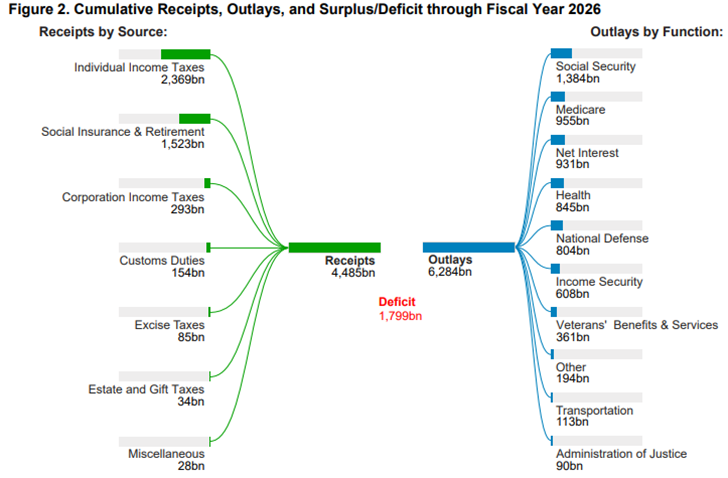
Historically, debt has risen sharply during wars, recessions, and other periods of economic distress, when fiscal stimulus was used to stabilize the economy. The difference today is that debt continues to grow rapidly even while the economy is expanding.
The COVID-19 pandemic accelerated the trend as the government spent trillions supporting households, businesses and the economy. But deficits did not return to pre-pandemic levels once the crisis ended.
Structural spending on Social Security, Medicare, defense and other programs continues to rise, while higher interest rates have made servicing the existing debt increasingly expensive.2
In fact, interest expense has become one of the largest items in the federal budget. In 2026, net interest expense is the third-largest spending item, only trailing Social Security and Medicare spending.3 This creates a challenging loop: the more debt the government accumulates, the more interest it must pay; the more it spends on interest, the less it has available for other priorities and needs such as funding infrastructure, defense and research.
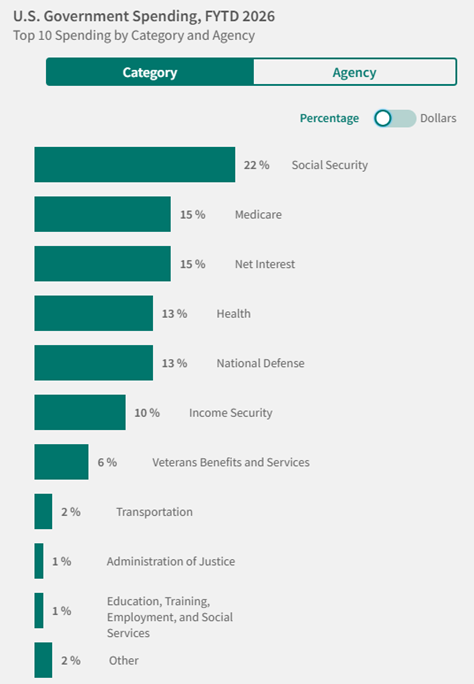
The implications of high national debt levels also extend beyond Washington: 2
- Bond-market volatility: Investors may demand a greater risk premium to hold long-duration Treasuries, potentially keeping long-term rates structurally higher.
- Higher borrowing costs: As rising debt and fiscal uncertainty push investors to demand higher yields on U.S. Treasuries, borrowing costs can increase across the economy, from mortgages and auto loans to credit cards and corporate debt, straining consumers’ pocketbooks.
- Crowding out: Heavy government borrowing can compete with the private sector for capital, potentially reducing investment and economic growth.
- Less fiscal flexibility: A heavily indebted government has fewer options to respond to a recession, financial crisis or geopolitical shock.
U.S. Treasuries are considered the world’s ultimate safe-haven asset. The dollar’s reserve-currency status, the liquidity of the Treasury market and the strength of the U.S. economy give the government significant advantages that other countries do not have and have allowed the U.S. to keep borrowing money relatively easily.
But those advantages do not make borrowing unlimited. As debt and deficits continue to grow, investors may increasingly demand additional compensation for holding longer-term U.S. debt, which in turn can increase the overall spending on servicing it.
This leaves policymakers between a rock and a hard place. Ultimately, the U.S. has three levers to address the debt burden: spend less, collect more revenue or grow the economy faster than the debt.
That could mean addressing Social Security and healthcare spending, and/or considering changes to taxation. None of these choices are politically easy or painless but will be necessary to prevent debt levels from spiraling even higher.
The $40 trillion milestone may not represent an immediate crisis, but it is an important threshold to watch and address. At Gradient Investments, we will continue to monitor these developments closely and evaluate their implications for fiscal policy, interest rates and global markets.
1 https://www.cnbc.com/2026/08/19/us-government-debt-passes-40-trillion-mark-for-the-first-time.html
2 https://www.npr.org/2026/08/20/nx-s1-5939473/40-trillion-federal-debt
3 https://fiscaldata.treasury.gov
The information provided herein represents the opinions of the author and Gradient Investments as of the date of publication and is subject to change without notice. This commentary is for informational and educational purposes only and does not constitute personalized investment advice or a recommendation to buy, sell or hold any specific security, including the companies named above. Forward-looking statements, including statements about industry trends, pricing and demand, involve risks and uncertainties, and actual results may differ materially. Investing involves risk, including the possible loss of principal. Data cited from third-party sources is believed to be reliable but has not been independently verified by Gradient Investments.