
By Lisa Schreiber
Last week’s US consumer sentiment survey, released by the University of MIchigan, delivered a striking signal about how Americans are feeling about the economy and their personal finances. The April reading fell to 47.6 – down from 53.3 the prior month and below the previous record low of 50 set in June 2022 – marking the weakest level in the survey’s more than 70-year history. [1]
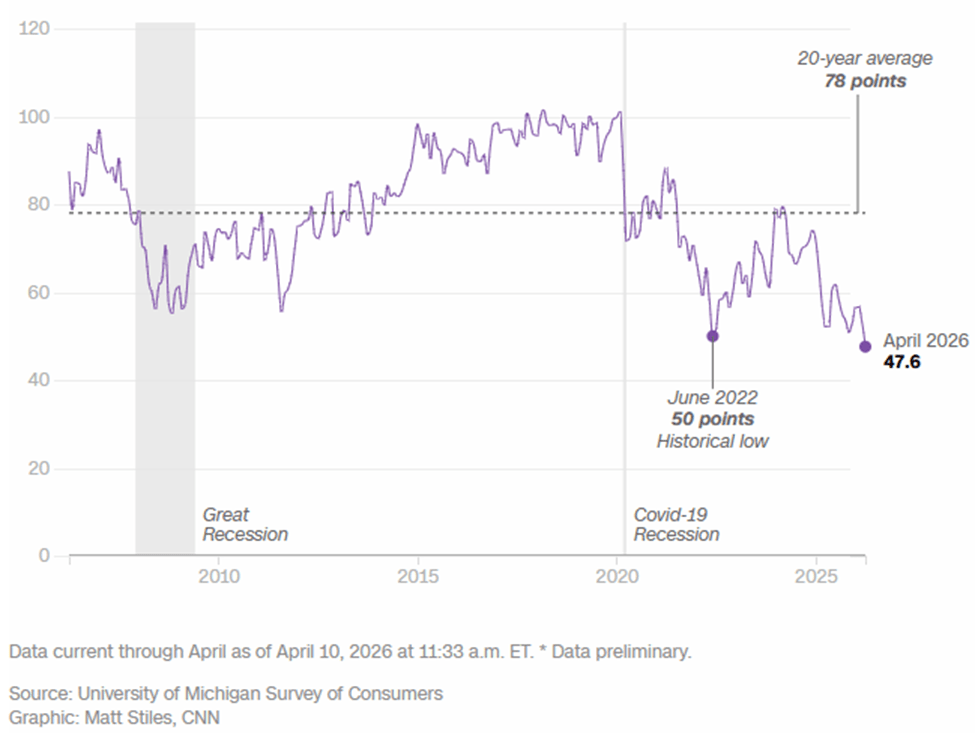
Consumer sentiment, also known as consumer confidence, measures how households feel about current economic conditions and their expectations for the future. It captures perceptions of wages, employment, inflation, business conditions, and personal finances.
Unlike “hard” economic data such as GDP, employment, or inflation reports, sentiment is a “soft” indicator; it reflects psychology and personal perception rather than actual economic activity. As a result, it can diverge meaningfully from what consumers are doing versus what they are saying.[2]
Recent weakness in sentiment has been driven by a combination of factors. Heightened geopolitical tensions, particularly surrounding Iran, alongside rising energy prices, have renewed concerns about inflation and economic stability. Higher fuel costs tend to have an outsized psychological impact because they are highly visible and directly affect household budgets.
At the same time, increased market volatility and ongoing policy uncertainty have added to a broader sense of unease. Importantly, the decline in sentiment has been broad-based across income, age, and demographic groups, suggesting this is a widespread shift in perception rather than a localized concern.[2]
However, it is crucial to separate sentiment from business fundamentals. Investor sentiment is a measure of mood. Business fundamentals are a measure of reality. While the two are related — fear can depress valuations, euphoria can inflate them — they operate on different timescales and respond to different inputs.
Sentiment is fast-moving, reflexive, and heavily shaped by narrative: headlines, rhetoric, geopolitics, and the ambient anxiety of news cycles.
While consumers report record-low confidence, underlying economic fundamentals remain significantly more stable. US economic growth, as measured by Gross Domestic Product, is still expected to expand at a moderate pace in 2026, broadly in line with long-term trends.[3]
Consumer spending remains at a healthy pace, largely driven by higher income consumers.[4] At the same time, corporate earnings within the S&P 500 have remained resilient, with continued growth expected despite geopolitical uncertainty, tariff risks, and elevated volatility. Profit margins also remain near historically strong levels, suggesting that businesses are adapting effectively to the current environment.[5]
While risks remain, particularly from elevated energy prices and their potential spillover effects on inflation and consumer behavior, the overall economic backdrop remains constructive and resilient.
This divergence between weak sentiment and relatively stable fundamentals is not unusual. As seen in the chart below, history suggests that extreme pessimism in consumer sentiment often occurs near market inflection points.
When expectations are already deeply negative, much of the bad news is typically reflected in prices and behavior. Conversely, periods of excessive optimism have often preceded more muted forward returns.[6]
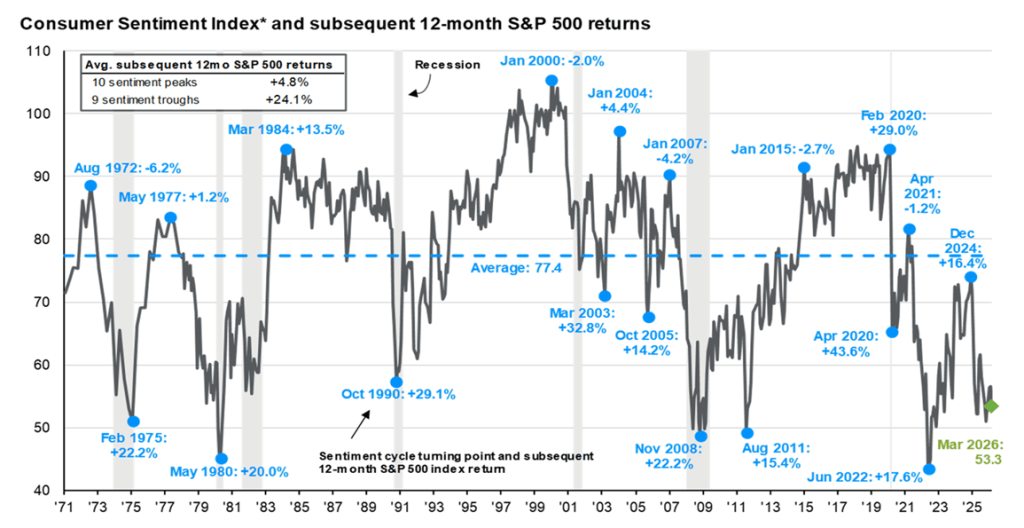
While consumer sentiment readings are a useful gauge of how US households are feeling in any given economic and market environment, they should be interpreted with caution and in the context of underlying economic and business fundamentals. Extreme readings, whether overly optimistic or pessimistic, can sometimes signal shifting market conditions and potential inflection points.
1 https://www.cnn.com/2026/04/10/economy/us-consumer-sentiment-record-low-april
2 https://www.nerdwallet.com/finance/learn/consumer-sentiment-what-is-it-and-why-does-it-matter
6 https://am.jpmorgan.com/us/en/asset-management/adv/insights/market-insights/guide-to-the-markets/