
By Lisa Schreiber
Nearly one year after “Liberation Day” — when the administration introduced sweeping tariffs on major U.S. trading partners, trade policy has taken another sharp turn. On Feb. 20, the U.S. Supreme Court ruled 6-3 against the administration’s trade policy and answered the question of whether the president has overstepped his executive authority by imposing certain tariffs without explicit congressional authorization.
The decision specifically addressed tariffs enacted under the International Emergency Economic Power Act (IEEPA) and the court ruled that the use of emergency powers in this context exceeded statutory limits.[1]
The ruling invalidates tariffs imposed under IEEPA authority, including:
· “Reciprocal” tariffs imposed on roughly 65 countries.[1]
· Drug-related tariffs imposed on Canada, China and Mexico.[1]
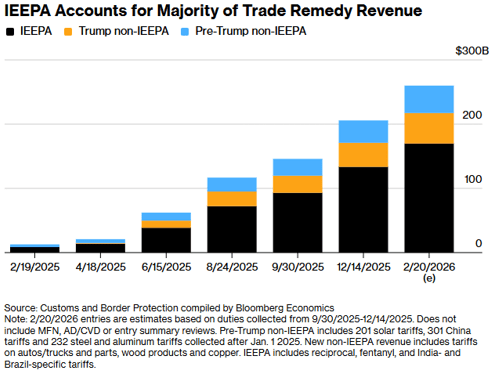
These tariffs accounted for approximately 60% of the total tariffs introduced since April 2025 as seen in the chart below.
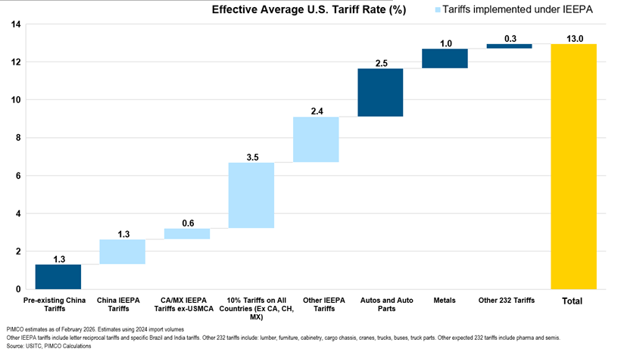
IEEPA tariffs represent approximately 8% of the current 13% average effective U.S. tariff rate, as seen in the chart below. Even if the effective tariff rate drops toward 5% following their removal, the effective US tariff rate still is the highest in decades — marking an increase from the 2.5% average rate seen in 2024. Elevated tariff rates — even if reduced — continue to influence companies’ pricing strategies, supply chains and inventory planning, exposing them to both tariff relief and new uncertainties.
The ruling also raises the question of whether tariff revenue collected under IEEPA must be refunded. The Supreme Court left that determination to lower courts, but the financial implications could be significant. An estimated $170 billion in tariff revenue collected by the Treasury may be subject to reimbursement and more than 1,500 companies have already filed their own tariff lawsuits in the trade court, seeking potential refunds.
History suggests the refund process would be slow and operationally difficult. A 1998 Supreme Court precedent resulted in $730 million tariff refunds and took around two years to resolve. Given that today’s potential reimbursement figure is exponentially larger, the litigation and administrative process could extend for several years, prolonging uncertainty for both businesses and the Treasury.[2]
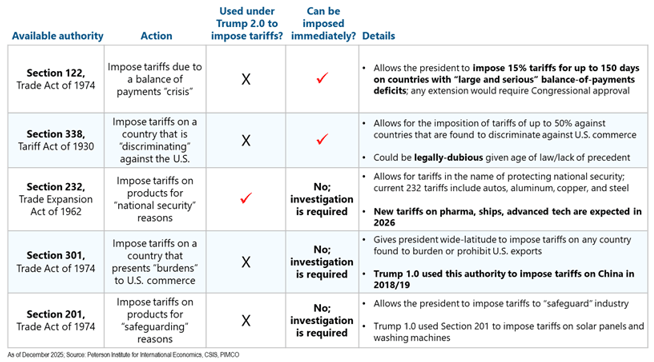
While IEEPA-based tariffs are struck down, the administration retains alternative trade authorities as seen in the table below, albeit with greater restrictions. In the press conference following the ruling’s release, the president announced immediate 10% tariffs under Section 122, later raising them to 15%. Section 122 allows temporary tariffs on countries with “large and serious” trade deficits, but they can only remain in place for 150 days before they require congressional approval to extend them.
Compared to IEEPA, these authorities are more constrained but potentially more durable once enacted. Another open question involves the roughly 20 trade agreements negotiated under the IEEPA framework, including arrangements with the European Union, the United Kingdom, and Japan. With the legal foundation now invalidated, counterparties may reassess their adherence to negotiated terms. [3]
Overall, the ruling provides partial relief but does not eliminate broader trade policy risk. Questions surrounding potential tariff refunds remain unresolved, alternative authorities may replace much of what was invalidated, and trade partners could revisit agreements negotiated under the previous framework. Policy uncertainty often creates short-term market volatility as seen around the “Liberation Day” tariff announcements in April 2025.
However, history consistently shows that staying invested in alignment with one’s risk tolerance, rather than reacting to short-term policy headlines, has proven to be the more effective long-term strategy. At Gradient Investments, we are observing the changing tariff landscape closely and will make portfolio adjustments if necessary.
[1] https://www.lpl.com/research/blog/eight-takeaways-from-the-supreme-courts-tariff-ruling.html