
By Keith Gangl, CFA®
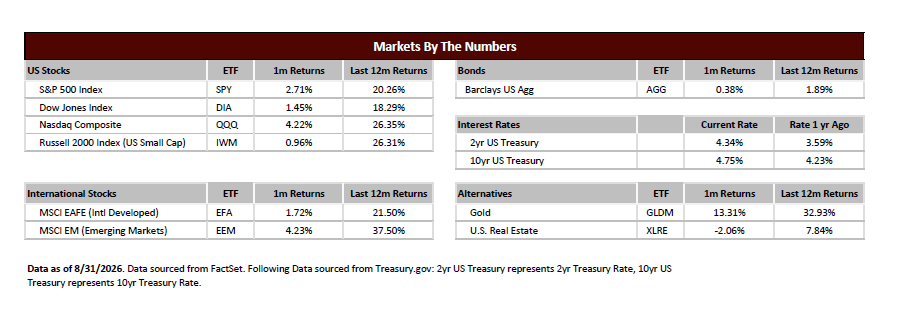
Stocks and bonds traded places in August, each reversing its July script. The S&P 500 had a ho-hum July but reaccelerated in August, while Treasury yields did the opposite: the 10-year yield rose rapidly in July, then leveled off and traded in a tight range in August. The S&P 500 gained 2.71% for the month, while the 10-year Treasury yield was essentially flat, sitting at 4.75%[1] at both the beginning and end of August.
Technology and energy sectors led the stock market’s August rally[2]. Megacap technology and software names, which had lagged the broader market earlier in the year, rebounded on the strength of solid earnings reports. Energy stocks were the other standout, propelled by elevated oil prices as escalating conflict in the Middle East raised concerns that supply disruptions through the Strait of Hormuz could persist.
The bond market told a quieter story in August, with the 10-year Treasury yield ending the month right where it started, at 4.75%[3]. That stability followed a sharp climb in July, when the yield jumped from 4.44% to 4.75%.
The broader rise in yields over the past two months reflects a mix of pressures: persistent inflation concerns, the possibility that the Federal Reserve could raise the fed funds rate, rising yields globally, and mounting government deficits.
Historically, rising bond yields create headwinds for consumers through higher borrowing costs, which can weigh on economic growth. Elevated yields also raise the cost of servicing government debt, a dynamic that investors are watching more closely now that total federal debt has crossed another threshold, surpassing $40 trillion[4].
August’s role reversal is a reminder that markets rarely move in a straight line. Just as technology stocks shook off a sluggish start to the year, the bond market’s pause after a turbulent July shows that even the most persistent trends can stall, at least temporarily.
For investors, the lesson is not to read too much into any single month’s performance, but to stay attentive to the underlying forces at work: earnings, inflation, Fed policy, and fiscal sustainability.
Looking ahead, the interplay between equities and rates should be more closely watched and could be one of the factors in determining the dynamic of this market cycle. If yields stay range-bound, risk assets may continue to find support, as they did in August.
But if inflation data or fiscal concerns push yields meaningfully higher, stocks, particularly the rate-sensitive technology sector that led August’s gains, could once again feel the pressure.
That said, August offered an encouraging sign: the strength of corporate earnings, especially among megacap technology companies, gave the market a fundamental reason to rally even as yields held near multi-year highs. As long as earnings growth remains resilient, stocks may be better positioned to absorb elevated rates than in past cycles.
With federal debt now above $40 trillion, however, the fiscal backdrop is no longer a distant concern; it could be a variable in how both markets behave in the months and years ahead.
[2] August S&P 500 Sector Performance
[4] US National Debt
The information provided herein represents the opinions of the author and Gradient Investments, LLC as of the date of publication and is subject to change without notice. This commentary is for informational and educational purposes only and does not constitute personalized investment advice or a recommendation to buy, sell or hold any specific security, including the companies named above. Forward-looking statements, including statements about industry trends, pricing and demand, involve risks and uncertainties, and actual results may differ materially. Investing involves risk, including the possible loss of principal. Data cited from third-party sources is believed to be reliable but has not been independently verified by Gradient Investments, LLC. Indexes provided are common industry benchmarks. Investors cannot invest directly in an index. All investments involve risk, including the possible loss of principal. Index and ETF returns shown are price returns and do not reflect the deduction of fees, expenses, or taxes. Past performance is not indicative of future results.